About Andrew J McKiernan

Andrew J McKiernan is an author and illustrator living and working on the Central Coast of New South Wales. His stories have been published in magazines such as Aurealis and Midnight Echo and in numerous anthologies. He has twice (2009 & 2010) been shortlisted for both Aurealis and Australian Shadows Awards, as well as a Ditmar Award shortlisting in 2010. His illustrations have appeared in books and magazine as well as gracing their covers. http://www.andrewmckiernan.com

The Awakening by Brett McBean – Reviewed by Greg Chapman

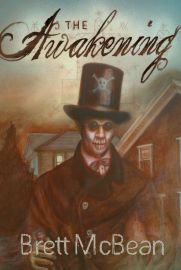
awakeningThe Awakening by Brett McBean
Publisher: The Asylum Projects/Tasmaniac Publications; First Edition edition (2012)
Paperback: 432 pages
ISBN: 978-0-9871-9492-3

The Awakening, by Melbourne horror author Brett McBean is a novel that proves the value of horror fiction as a story.
For horror to work it has to have heart, not only in its characters, but also in what the story is trying to say and McBean lays the “heart” on thick in this tale.
And at its heart, The Awakening is a tale about a boy growing up, but it’s also an intricate exploration of prejudice, retribution and forgiveness.
The basic premise of the story centres on young Toby, a boy on the cusp of adulthood and his curiosities about life after grade school, girls, alcohol – and the strange old man across the street – Mr Joseph, a black man, who many in the town regard as a freak.
McBean takes his time in the first half of the book, moulding Toby, Toby’s parents and friends and creating an air of mystery around Mr Joseph, but when another stranger arrives in town, an apparent acquaintance of Mr. Joseph’s, the story goes into overdrive.
After Toby and his friend are brutally attacked on their way to an after school party, Toby is set on a path where he gets to know Mr Joseph on a very personal level and we discover the old man’s origins and a dark past that takes us back to Haiti and zombis!
Through the course of their interaction, Mr Joseph teaches Toby about the real world, but at the same time the old man learns a lot from the boy, especially about letting go of the past.
With an overload of zombie fiction, involving viruses or plagues, it was a joy to have McBean take the zombis back to their Haitian roots. The author, in my humble opinion, made the monsters worthy again.
And with great skill McBean manages to weave everything together for an edge of your seat climax where many mysteries are solved and the characters we’ve cared for are actually “re-awakened”.
The Awakening reminded me a lot of the film Stand By Me, based upon a story by Stephen King, yet it stands on its own as a new classic in not just the horror genre, but fiction as a whole.
I should also congratulate Tasmaniac Publications for creating the wonderful hardback edition of McBean’s book, including Erin Wells’ interior art and Ray Garton’s inspired introduction. The end product speaks very loudly to the fact that an e-book just can’t shine a light to a proper paper book made with love.
Although the limited edition hardback has sold out, rumour has it that a paperback edition will be released in the near future.
Highly recommended.
Review by Greg Chapman (http://www.darkscrybe.blogspot.com/)

Review: Fragments of a Broken Land: Valarl Undead

Fragments of a Broken Land: Valarl Undead
By Robert Hood
Publisher: Borgo Press/Wildside Press
Paperback: 432 pages
ISBN: 978-1-4344-4589-6

Blurb: In a place where no stars appear in the night sky, a group of strangers whose ancestries reach back to an earlier apocalyptic disaster are brought together to track down a resurrected corpse that might hold the key to the End of the World. Described by science fiction legend Jack Dann as “one of the strangest and most interesting visions to come out of the modern horror/fantasy genres,” acclaimed author Robert Hood’s Fragments of a Broken Land: Valarl Undead is an epic tale of greed, dying magic, strange monsters, and a motley group of heroes, with a strange and breathless climax you won’t easily forget.

When I think of Fantasy as a genre, I don’t often get the modern Epic Fantasy image of Dwarves and Orcs and Elves questing through majestic forests in my mind. I’ve always been more drawn to the works of Clark Ashton Smith, Fritz Leiber, William Hope Hodgson, Robert E Howard, Jack Vance, M. John Harrison and Michael Moorcock. Their fantasies were always so much more ‘otherworldly’ than the faux-Europes and other earth-analogues of modern Epic Fantasy. Their worlds were far-distant not only in ‘place’ from our own, but often also far-distant in ‘time’. Long past or far, far in the future, they were as foreign and exotic to the reader as if they really had just stepped into another country and culture.

Fragments of a Broken Land: Valarl Undead, the debut adult-novel¹ from Robert Hood, has this Otherworldliness in spades. The ‘world’ of Tharenweyr is as strange and exotic a place as has ever existed in fantasy fiction. Indeed, it is not even a world but a solid firmament (or a ‘seed-like emanation’ as Hood puts it on his website) that exists separate from space and time as we know it. It has no sun or moon or stars. Not even the infinite void of space to stare into. Instead, Tharenweyr is locked within its firmament, a mysterious wave of energy that washes from the ‘Worldly Gods’ of the north to the ‘Dark Gods’ of the south and creating the semblance night and day.

The novel begins with Remis, a young and newly graduated spellbinder interested in starting her own magical artifacts business, who is being pressured (threatened, intimidated) into working for a powerful Merchant House. She’s also having horrible nightmares in which she finds herself trapped inside the body of a hideous corpse-like being. And then there’s Tashnark, the bastard son of a commercial slaver. He’s having dreams that he is the powerful warrior Bellaroth, questing across some strange otherworld that exists on the shoulders of a vast cosmic monster.

It is the chance meeting of Remis and Tashnark – their respective dreams unknown to each other – that sets the course of lifting Fragments of a Broken Land.. out of individual nightmares and into a fantasy who’s cosmic scope rivals anything by Lovecraft or William Hope Hodgson. Gods battling Gods. Ancient artifacts and the prophesised return of catalysmic events that will wipe Tharenweyr out of existence. And, as always, Gods using normal people as their pawns.

In the hands of Robert Hood Fragments of a Broken Land… becomes so much more than just a Fantasy or Sword & Sorcery adventure though. The philosophical and spiritual underpinnings Hood has evoked for the world and its people almost demand a denser tale. In this sense, Hood certainly delivers. At times Fragments of a Broken Land… can be a hard read. You need to concentrate a bit. Divest some of your attention in the book. But believe me, the effort is worth it; Fragments of a Broken Land… will have your brain spinning in Gnostically-induced circles.

One thing that really did stand out for me is Tharenweyr’s main city of Ko’erpel-Na. The characters of Fragments of a Broken Land… all have a wonderful depth — their sense of humour, of justice, the way they try and interpret their world and the way they react to it — but the city is just as much a character too. It reminded me of Fritz Leiber’s Lankhmar or M. John Harrison’s Viriconium. It’s dirty, it’s crowded and full of disease and poverty, but there is also a feel to Ko’erpel-Na that speaks of age and so many lives lived within its walls. The impression I got of the city and its people was quite vivid, quite ‘real’. It seems a place just begging for a million more tales to be told.

Overall, Fragments of a Broken Land: Valarl Undead is a brilliant fantasy novel of the type we seldom get to read these days. Dense and exotic and full of ideas. It’s also full of sword & sorcery action too, and the type of cosmic horror that leaves you paranoid about your own reality. Really, what more could you ask for in a book?

Don’t believe me? Want to check it out for yourself? Mr Hood has three other Tharenweyr ‘Fragment’ stories to read for free on his website [http://fragmentsnovel.undeadbackbrain.com/]. Definitely worth checking out as a teaser and to get a feel for the world before tackling the very worthy Fragments of a Broken Land: Valarl Undead.

Oh, and the cover by Bob Eggleton? It is brilliant!

Footnote:
1. Robert Hood is the author of 5 previous Young Adult Novels, 15 Children’s books, published 3 collections of his own work, and edited a further 5 anthologies.

Review: Witch Hunts – A Graphic History of the Burning Times

witch-hunts-a-graphic-history-of-the-burning-timesWitch Hunts – A Graphic History of the Burning Times
By Rocky Wood & Lisa Morton
Illustrated by Greg Chapman
Publisher: McFarland
Paperback, 186 pages
ISBN: 978-0-7864-6655-9

Blurb: For three centuries, as the Black Death rampaged through Europe and the Reformation tore the Church apart, tens of thousands were arrested as witches and subjected to torture and execution, including being burned alive. This graphic novel examines the background; the witch hunters’ methods; who profited; the brave few who protested; and how the Enlightenment gradually replaced fear and superstition with reason and science. Famed witch hunters Heinrich Kramer, architect of the infamous Malleus Maleficarum, and Matthew Hopkins, England’s notorious “Witchfinder General”, are covered as are the Salem Witch Trials and the last executions in Europe.

Way back when I had just started High School I discovered, in the library, graphic novel versions of Shakespeare’s Hamlet, Othello and Romeo and Juliet. There were also graphic novels of the life of Genghis Khan and Alexander the Great. They were brilliant. They not only introduced me to wealth of historical figures and to Shakespeare’s genius but they cut through all the hard work of the original texts. They presented art and history in a visual way that made the past exciting and interesting. It is something that stuck with me. It is something that helped pave the way for my own journey to becoming a writer and illustrator.

What has ‘Witch Hunts – A Graphic History of the Burning Times‘ to do with this?

Well, I think they’re much the same. On opening ‘Witch Hunts…‘ for the first time, I was struck with a wave of nostalgia. Like I was that little kid in the school library, just now pulling down one more book after all these years. Within a couple of pages —  or maybe it was only a couple of panels — I was hooked.

Witch Hunts – A Graphic History of the Burning Times‘ begins with a brief introduction, an overview that sets the direction and tone of the work. There’s a bit of time-jumping in the chronology of this section, but bear with it. ‘Witch Hunts…‘ very soon settles into a detailed chronological telling of ‘The Burning Times’ (roughly 14th to 18th centuries) and beyond to the horrors still perpetrated around the world today.

A couple of things struck me about ‘Witch Hunts…’. Firstly, the obvious knowledge of the authors is there in every word. It was sort of amazing to me, as I read, to see how much history they’d encapsulated within such short bites. To distil all that information down to just a few words shows a real depth and understanding of the subject matter. Also, I felt I learnt more, retained more, and enjoyed it more than I ever have any history text-book. HWA President Rocky Wood and Bram Stoker Award winning author Lisa Morton really have to be congratulated on achieving such a feat.

Secondly, the artwork by Queensland author/illustrator Greg Chapman is spot on for the work. The style is not that of the modern ‘comic’ — all mood, bold blacks filling 80% of a panel — but much more what I remember from those old Illustrated Classics in the library — less chiaroscuro, more detail, more character. Again, as with the authors, the research that must have gone into each and everyone of Chapman’s illustrations is mind boggling. To be honest, I’m no expert on any of this stuff, but every page looks authentic. The clothing, the hairstyles, all the little objects in the background. They mesh perfectly with the narrative, really drawing you into the stories that Wood and Morton are telling.

The overall narrative is one we’re all familiar with through the culture of horror-literature and -cinema: that despicable period of inhumanity that began with the Spanish Inquisition and spread as Witch Hunts and Witch Trials throughout Europe and the New World. But Wood, Morton and Chapman take us beyond that; back to the religious and biblical origins of ‘Witchcraft’ as an evil and as a sin in the introduction, then later beyond the 18th Century. They also delve deeper. They offer up an onslaught of historical events and incidents. Grotesque images by Chapman. Individual things that happened to individual people, and these people had names. Sure, I’d sort of read and seen TV docos on the sort of things that the Catholic Church did in the 15th Century, or what occurred in Salem. But never before has this history been shown to me on such a personal level. As I said, these people had names, and now I know some of them. That has to bring anyone closer to history, doesn’t it? Gets you right in there, and you begin to really understand what these people went through. Isn’t that what learning history is all about?

That’s where ‘Witch Hunts – A Graphic History of the Burning Times‘ really worked for me. It showed me stories of real people. All the horror and the torment they went through and all the madness of the people who’d condemned them. It certainly is graphic — Chapman’s illustrations are often more uncompromisingly gruesome than the text — but it serves to show a truth about our past that we should not shy from. In light of some of the religious and political events happening around the world today, remembering that truth seems, to me, an especially important thing.

Ultimately, ‘Witch Hunts – A Graphic History of the Burning Times‘ is informative in a way few non-fiction works are, and it’s great-looking too! Definitely a worthwhile addition to any horror reader’s or writer’s library.

News: EVIL DEAD Redband Teaser Trailer

The new EVIL DEAD teaser trailer is out. I wasn’t too bothered about this film being made. I thought it was a bad idea, but hey, Sam Raimi and Bruce Campbell are behind it. And the thought of a female Ash? If they can do the same as they did for Starbuck in BSG, it’ll work really well. But, it wouldn’t really be EVIL DEAD would it? Most remakes are pretty bad, and I guess I was expecting this to be the same.

Well, I just watched the teaser trailer and, ummm, well, just wow. Such a short clip;so much in there. It tells you; this is something you are familiar with, we’ve all been here before. Very quickly you realise though; same story, same setting, but this isn’t the cheap and cheesy gore of the original EVIL DEAD. This is, well … there were a couple of moments when I flinched, or felt a very strong urge to turn away. This is EVIL DEAD the ‘realistic’ version, I guess.

Frankly, it looked amazing. Totally disturbing, with the sort of imagery that tends to stick in your mind for years. And, you know, it looks so good that I don’t even know if I’ll actually be able to watch it (woos that I am).

Anyway, needless to say, this very short teaser trailer with so much packed in NOT SAFE FOR WORK. NOT SUITABLE FOR CHILDREN. DO NOT SHOW IT TO YOUR GRANDMA!

Review: Terra Magazine Issue #1

Terra Magazine, Issue #1
Edited by Jason Franks
ISBN: 9781921872167
Publisher: Black House Comics

Terra Magazine, from Sydney-based Black House Comics, is a throw-back. A return to comics of a different era. Without political or social agenda, they were made to entertain; to shock and to thrill and to make you laugh. In many ways, Terra Magazine reminds me of that. Of EC Comics and early 2000AD.

In Terra Magazine‘s first issue, editor Jason Franks has assembled a varied collection of artists and writers. And an even more varied collection of genres. The almost Frazetta-like cover by Jason Paulos, the first thing that will catch your eye on the news-stands, is a brilliant evocation not only of the first story (see below), but also of the pulpish nature of the entire comic/magazine.

From the opening “Gourmand Go in ‘Memorial Soup’“, written by Franks with artwork by Harry Purnell, we are thrust immediately into deep space. This is exactly the sort of tale I remember reading in old 2000ADs; a ship crewed with human mercenaries, stuck drifting due to a busted Fission Drive, their distress signal picked up by the biggest, ugliest, meanest looking cockroach-lobster aliens in the galaxy. But you just know there is going to be a twist. While not exactly unpredictable, the story is fun. The writing is clear and concise and the artwork crisp and quirky.

Next up, we’re off to feudal Japan for “Kensuke“. Written again by Franks, but with artwork by Tom Bonin, this story couldn’t be more different than the opener. What struck me most was the total change, not only of genre, but of the feel of the artwork. While Purnell’s art for “Gourmand Go…” consisted of crisp line-work and lettering, Bonin’s approach in “Kensuke” is much rougher, sketchier, offering up a style more in line with the setting. And the story? Samurai warriors. Martial arts monks. Court intrigue. Concubines. Ninjas. Need I say more?

It is these shifts in genre and style that make Terra Magazine so much fun. The very next story, “The Catamorph“, with a script by Chris Sequeira and art by Jan Scherpenhuizen, places us firmly back in EC Comics ‘Tales from the Crypt‘ territory. Two cops respond to a break and enter alarm from the posh-end of town only to encounter a — quite animated — Ancient Egyptian mummy, and so much more besides. The script and artwork are sort of timeless in this supernatural-noir tale. It could be the 60s, or the 70s, or any decade onwards. I tend to favour a late 80s setting – wait until you see the push button phone in the Police Office! Apart from these initial panels though, there isn’t much in the way of visual clues to tell us exactly ‘when’ we are… and I see this as a good thing leading forward for “The Catamorph“. As I said: timeless.

Shadowmancy: Episode 1, The Key in the Wall“, with a script by Jason Franks and art by Nicholas Hunter, continues on in a similar mode. The artwork is more modern, with sharp Manga-inspired lines, but the story is still straight out of something I would have read as a kid in the 70s and 80s. For me, a new and refreshing take on that nostalgia seems to be what Terra Magazine is all about. In “Shadowmancy…“, young Quay decides the follow his mysterious and often absent father, only to find himself the centre of a battle between powerful sorcerers at a secret academy. The panels in this segment are really well composed. The script is sparse and increasingly intriguing. Once begun, I just had to keep going through to the end … and this is where I was reminded of what might be Terra Magazine‘s single downfall.

The story sequences are just too darn short!

Of those reviewed so far, only “Gourmand Go…” has anything resembling a self-contained story. I’m hoping for more stories set on that deep space kitchen, but if not, that’s okay. Everything else, though? Yep! To Be Continued…

It might not be so bad if the stories weren’t all so good. So much fun. Maybe then, I wouldn’t have to worry about the wait between issues. But, tri-annual? I have to wait one third of a year before I get to see if Imperial Guard Kenuke gets away? Or whether detectives Vic and Doyle get any closer to discovering the Mummy’s secret? That’s quite a torturous wait for a reader, especially when the story crumbs are so small (but oh so tasty). “Shadowmancy...” was, to me, the most interesting story in terms of future development, but just for one more page, or another two pages, or three! I definitely feel it could have given more.

Gun Smoke Bud“, with a script by Jason Franks and art by Yuriko Sekine, is in a style I’m not overly familiar with. I’m guessing it’s manga inspired. The story is simple enough — Two Tokyo detectives investigate a Yakuza massacre at a shopping mall, their only witness? A young stoner — but it doesn’t give us much indication of where it might be heading in the future. And after the crisply stylised lines of “Shadowmancy“, the artwork didn’t do that much for me.

The final panelled story is Ben Michael Byrne’s “Prototype“. Written and illustrated by Byrne, “Protoype” is another short, self-contained, 2000AD style sci-fi story. Nothing serious, just good fun with the usual gruesome twist at the end. The darker, blockier artwork really suits the piece and it is quite different from anything else in the magazine. I can see this continuing with a new short, and comically-nasty, story each issue.

Which brings us to the final story, “Tusk” by Jason Fischer, which isn’t a comic at all. Still in keeping with the serialised nature of the magazine, “Tusk” plumbs the Golden Age of genre fiction with something that could have come right out of an early 70s issue of Analog. “Tusk” is straight prose — with a few Rhys James illustrations sprinkled throughout — of the sort that Mr Fischer has become well known for: tight, well written, original and more than a little bit gonzo. “Tusk” is The Planet of the Pachyderms with a healthy dash of Robert E Howard thrown in. A post-apocalyptic world run by a civilisation of war-like elephants. Talking warrior elephants, no less. Who enslave humans. And they wear ‘swords’ on their tusks! Count me in! Not only are the battle scenes tremendous, but there are hints of a much deeper story developing here. I very much look forward to reading more of “Tusk” in future issues.

So, that’s that. My non-comicaknowledable take on what I think is a really excellent debut. Terra Magazine is a great blend of exactly the sort of comics and tales that got me reading as a kid — a wonderful retro revival that, despite its obvious influences, still offers something new and refreshing for readers of both comics and of genre fiction. It should be available on your local newsagent and comic store now, or you can visit www.terramagazine.com.au Let’s hope Black House can keep the issues coming!

In the Footsteps of Dracula by Steven P. Unger

In the Footsteps of Dracula: A Personal Journey and Travel Guide
Author: Steven P. Unger
Publisher: World Audience Inc.
ISBN: 9781935444534 (pbk.)
Published: 2nd Edition, 2010

Author:
Steven P. Unger has been a traveler and writer from the time he learned to type with two fingers on a manual typewriter in the basement of his parents’ house in Ferndale, Michigan. He still travels, writes and types with two fingers.

Blurb:

Worldwide fascination with Dracula, like the bloodthirsty Count himself, will never die. Completed and comprising approximately 35,000 words and 185 photographs, In the Footsteps of Dracula: A Personal Journey and Travel Guide is the first and only book to include … pictures and descriptions, in memoir form, of every site in England and Romania that is closely related to either Bram Stoker’s fictional Count Dracula or his historical counterpart, Prince Vlad Dracula the Impaler.

It’s not often that, as a reviewer of dark fiction, I get the chance to review a travel guide. Even less often do I enjoy reading travel guides at all. In the Footsteps of Dracula: A Personal Journey and Travel Guide is most certainly an exception.

Almost equal parts memoir, travel guide, history lesson, and an examination of fact and fiction (most particularly the Dracula myth), author Steven P. Unger weaves us effortlessly through the various styles. One minute you’re with him, standing on the fabled Borgo Pass, and the next you’re fascinated by the area’s historical links (or lack thereof) with Bram Stoker’s most famous novel.

Unger’s travels focus only on places mentioned or verified as inspiring the fictional Dracula, or those of the historical Vlad Tepes. In this way, he avoids most of the more ‘kitschy’ tourists haunts that have been created in the novel’s wake. Instead, his destinations include the less gaudy, but so much more interesting, Whitby Abbey (the real Carfax Abbey), Poienari (the real Castle Dracula), and the Reading Room of the British Museum. It is in these places that Unger discovers links between Dracula and Vlad Tepes that even Bram Stoker had no prior knowledge of.

The text is well broken up by an abundance of photographs too. Evocative images of bleak Romanian landscapes and abandoned abbeys do much to help keep you engrossed in the words. My only disappointment while reading was that all of the pictures are black and white. Sometimes I’d turn a page and just wish an image was in colour – it is a minor and selfish quibble, and does more to reflect the good choice and placement of photos than any real deficiency with the book.

Overall, the tone of the writing is never dry or overly academic. Unger sucessfully conveys his own wonder and disappointment at the places he visits, and his investigations into their legitimacy as part of Dracula folk-lore are always full of surprises.

The final section of the book, ‘Part V – Nuts and Bolts: A Practical Guide to the Dracula Trail‘, somewhat dispenses with the memoir and historical portions of the narrative. Instead, it focusses on the practicality of following Unger’s journey. This section of the book – a collection of travel tips on topics including: money, security, public transport, food and accomodation costs, and health – will prove indispensable to those who wish to visit the places that inspired Stoker’s Dracula.

I don’t plan on going anywhere far, but nevertheless, I found this book fascinating. There were so many ‘I didn’t know that!’ moments. And Unger’s own personal fascination with the history (fact or fiction) behind Dracula’s origins was certainly infectious enough to make it feel like I was there with him.

In the Footsteps of Dracula: A Personal Journey and Travel Guide is a book I very much enjoyed reading, and even if you’re not a traveller, it certainly should be on the shelf of anyone interested in the origins and ispirations for Bram Stoker’s Dracula.

Darkness On the Edge of Town by Jessie Cole

Darkness On the Edge of Town
Author: Jessie Cole
Publisher: Fourth Estate – HarperCollins
ISBN: 9780732293192 (pbk.)/9780730493853 (ebk)
Published: July, 2012

Author:
Jessie Cole was born in 1977 and grew up in an isolated valley in northern New South Wales. In 2009 she was awarded a HarperCollins Varuna Award for Manuscript Development, and her work has appeared in Kill Your Darlings, Meanjin, and the Big Issue. Nowadays, she lives in her childhood home with her two sons.

Blurb:

My dad, he collects broken things…
Where other people see junk he sees potential…
My dad collects broken people too…

Vincent is nearly forty years old, with little to show for his life except his precious sixteen-year-old daughter, Gemma: sensitive, insightful and wise beyond her years.

When a stranger crashes her car outside Vincent and Gemma’s bush home, their lives take a dramatic turn. In an effort to help the stranded woman, father and daughter are drawn into a world of unexpected and life-changing consequences.

DARKNESS ON THE EDGE OF TOWN is a haunting tale that beguiles the reader with its deceptively simple prose, its gripping and unrelenting tensions, and its disturbing yet tender observations.

By the time I’d finished reading Varuna Award winning Jessie Cole’s first novel, Darkness On the Edge of Town, I still really had no idea why it had been titled after a 1978 Bruce Springsteen album. Yeah, sure, there are some goings on at the edge of town, but its not really a Darkness.

Maybe it was that title, coupled with the front cover quote from Robert Drewe – ‘So frighteningly real, it grabs you and shakes you.‘ – and the lines in the back cover blurb about a ‘haunting tale‘ and ‘gripping and unrelenting tension‘ and its ‘disturbing yet tender observations‘, that had my expectations going but I didn’t find the novel particularly dark, haunting, unrelenting or disturbing.

If you can put the misdirected marketing aside though, Darkness On the Edge of Town is still a very good first novel.

Set in and around a rural town the novel opens with Vincent, late thirties, single dad, driving home from the pub. As he rounds the final bend to his house, he comes across an overturned car. Lights still shining and engine running. At the side of the road squats a girl, looking “kind of crumpled and broken“. In her arms she holds a baby. “Its body was limp, its eyes closed.

It is the appearance of this girl, Rachel, into the lives of Vincent and his sixteen year old daughter Gemma, that drives everything to come in the novel.

The story is told from the alternating first person accounts of Vincent and Gemma. Vincent’s chapters are written in a simple, almost ordinary, prose and this very much sums up the nature of Vincent himself. Unfortunately, Gemma’s voice is very similiar and I couldn’t find much to distinguish them. There is a gentle poetry to this simplicity of no-nonsense prose though, and it keeps you turning the pages.

Another thing that keeps you turning the pages is the building of various tensions. Vincent’s need to help Rachel and bring her into his house has ramifications for just about everyone in the small town. From his daughter Gemma, just turned sixteen, and how this new, damaged, house guest changes her view on her own relationships; with her father and with her potential boyfriend. Threats and jealous ravings from Vincent’s ‘current’ girlfriend Marie. The gossip that fills the town. And Vincent’s own quickness to anger, his innner turmoils questioning the morals of his decision to allow Rachel to stay at their house, and indeed, to sleep in his bed.

There’s a constant thread of the ‘threat of violence’ throughout Darkness On the Edge of Town, too. It is another one of those tensions, probably the major theme, and the author makes a concerted effort to crank it up towards the end. Unfortunate then, that I can’t say it ever really pays off. The climactic scenes seem as constrained as the rest of the prose and fail to lead to the promises of the title, the blurb, or even the story itself.

Overall, Darkness On the Edge of Town is still a well written novel. I read it quickly, and effortlessly, and at no point did I want to put it down. But it never seems to address its themes in any real depth, or at least not enough to make me really feel for any of the characters. What they go through over the course of the story you wouldn’t wish on anyone, but for me the author failed to fully convey that. Which was a shame, because after everything that happened to Vincent and Gemma and Rachel, I really did want to feel something for them.