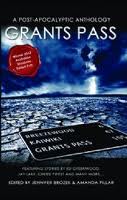
Book Review: Grants Pass, edited by Jennifer Brozek and Amanda Pillar

Morrigan Books, 2009

I was first sent a review copy of Grants Pass when it was published in 2009. In the time it took for me to get around to reading and reviewing it three years later (like, er, y’know, now), it picked up the 2010 Australian Shadows Award for edited publication - and,now that I’ve finally had the pleasure of devouring the book for myself, I can see why.

Like many good things, Grants Pass was a long time in the making. The concept originated from a blog post by Jennifer Brozek in 2004, a “thought exercise” positing the notion that, when the world ends, everyone should meet in a pre-destined place to pick up the pieces and carry on. The responses Brozek received led her to the idea of the Grants Pass anthology, which, after much pitching and reworking, came to fruition in partnership with her co-editor Amanda Pillar and publisher Morrigan Books. Brozek’s original blog post was used as inspiration for a journal entry by Kayley Allard which kicks off the anthology, and provides the central point (and a sort of meta-character-contributing-author) around which the entire book revolves: “when the end of the world comes, meet me in Grants Pass, Oregon”.

The end of the world does indeed come, thanks to three plagues released by terrorists (why, who, how, and to what end other than total annihilation of the planet is not explained), and a wave of very nasty natural disasters. Eighteen stories nestle between the covers of Grants Pass, detailing what comes next for survivors of the apocalypse. Each of the stories are never anything less than very good. Some are superb.

The standout piece for me was definitely Animal Husbandry by Seanan McGuire. A bleak, blunt story with an ethically curious core, this one stayed with me long after I put the book down. Touching on themes of euthanasia and humans as “domesticated animals” (I particularly enjoyed that perspective), and pulling no punches, this is an important, expertly told story. I remain perplexed as to where I stand on the protagonist’s actions. A very clever unexpected tale.

Several other stories were also striking (well, they all were, in their own unique ways – and that’s astonishingly rare in an anthology - but I’ve decided not to cover every story in this review, so will stick to the few that really leapt off the page at me). The disturbingly poetic Hell’s Bells by Cherie Priest was told from the point of view of a troubled young child with a morbid fascination with death and the bells that toll for it, and very little regard for human beings in general. Ascension by Martin Livings was probably the most original take on the end of the world theme, told from outside the planet looking in, and involving a stroll through space that truly chilled and moved me. Black Heart, White Mourning by Jay Lake introduced a frightening and unlikable mentally ill protagonist who I found myself nonetheless sympathising with due to Lake placing me squarely inside the character’s head – an impressive feat of authentic dialogue.

Grants Pass is vaguely reminiscent of Stephen King’s The Stand, what with the whole “illness wiping the world out and survivors being their own worst enemies” thing, though there is no religious apocalypse or any supernatural elements at all in the anthology – all the tales are very human indeed, and centred in a gritty, realistic future dystopia, told from various points around (and in one instance, outside) the globe. The horror in Grants Pass stems from these truths: people we love die and we can’t stop it, life is fragile, people can be terrible, loneliness can bring madness, and survival is something almost all of us have never really had to fight for before – and would be ill-prepared to do so if forced to.

I think the ultimate strong point of Grants Pass is its cohesiveness – the shared character (Kayley) and theme (Kayley’s blog post urging survivors towards Grants Pass) work to provide a united suite of stories and an immersive reading experience, which in turn forms an irresistible emotional connection between reader and words. Post apocalyptic fiction needs to make us care, or it just falls flat. Grants Pass made me care, and broke my heart more than a few times over.

Grants Pass has few weak points, and really I’m only pointing them out here for the sake of pure objectivity, so as not to write a review that is in fact just gushing praise (which is what I really want to do). One or two stories, whilst beautifully rendered, felt somewhat more like settings than fully developed narratives, but I enjoyed them nonetheless. The very cohesiveness that works so well for the collection can also bring a feeling of “sameness” and repetition; I liked that feeling, but some readers may need to take a break before diving back into the book to truly appreciate it. A few stories were harder for me to connect to because their locations and language were so far removed from anything I’ve personally experienced – but that in itself is a blessing, an educational journey within print – and I liked that not every story was set in the same geographical location.

Quite simply, I didn’t want this book to end. Highly recommended. Morrigan Books regularly release stylish, top-quality literature, and Grants Pass is no exception. It’s 2012; there’s no better time to read about the end of the world, and few better places to read about it than Grants Pass.

Moo-Vees.co.uk Plagiarising Reviews

As one TOC commenter (thanks, Brad) kindly pointed out, Moo-Vees.co.uk has reprinted TOC’s review of The Devil Inside in its entirety word-for-word (they even stole our formatting!), without our permission, without a by-line (in fact they’ve titled it “The Devil Inside Moo-Vees Review” as if it were theirs), and with the only nod to TOC being a hyperlink hidden in the body of the review within the movie title, and citation of TOC at the end of the review as a “reference”.

If you feel the need, you can see the plagiarised review here (however, try not to visit the site, they don’t deserve more hits and money for their poor behaviour). I assume burying a hyperlink to our site where it will never be found and listing us as a “reference” was an attempt to sidestep precisely this sort of attention.

Upon visiting that site, it’s evident that this is pretty much the sole extent of what they do – plagiarise reviews from other sources and post them on their own site, presumably to attract traffic (which they get plenty of if the hundreds of spam comments on each review are any measure) to justify their advertising - someone at that site is making money from other people’s reviews, in other words. Their site has no means to contact those responsible for posting, which is understandable – it’d get quite tiring constantly being held to account for having stolen the work of others, I suppose.

Ain’t nothin’ safe on teh interwebs, and there’s not much we can do about this, but the least we can do is simply point out what’s happened. Reviewers, beware: Moo-Vees.co.uk may be profiting from your work, too.

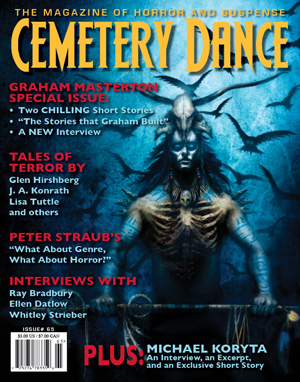
Cemetery Dance #65 – Graham Masterton Special Issue – review by Greg Chapman

Cemetery Dance #65CEMETERY DANCE MAGAZINE #65
GRAHAM MASTERTON SPECIAL ISSUE December 2011 (ISSN: 1047-7675)
Cemetary Dance Publications

OK, full disclosure: I’m only new to reading Cemetery Dance Magazine, having started reading from issue #61, but from that very first issue I was hooked, eagerly awaiting its appearance in my mailbox every few months from the US.

As a reader and writer of horror I have found the magazine and its contents to be essential, with its fiction, non-fiction, reviews and opinion pieces always providing me with insight and inspiration.

Issue 65 is a massive issue, profiling the work of UK horror legend Graham Masterton and including two new stories by him. In total the issue contains 10 new short stories and four interviews and five other features and of course all the usual fare of reviews, news and publishing trends. The issue apparently experienced some delays in production and did take longer than expected to arrive, but it was still – and always will be – worth the wait.

The issue kicks off with the Masterton interview – a fascinating Q&A, which provides an insight into a truly captivating author. He talks candidly about his time as the author of several sex guides, but its Masterton’s comments on how he only recently came to admire his novel The Sleepless that I found the most interesting, because I (and many more of his fans) believe it’s one of the best books he’s ever written.

Masterton’s two new tales provide proof of his skill. Anka is a chilling tale of the real-life horror of child neglect, melding with the Baba Yaga myth. In his typical style, Masterton gives the characters plenty of heart and soul, only to terrify them with equal measures of ghastly imagery and little hope for a happy ending.

Saint Bronach’s Shrift however is reminiscent of a parable, with two brothers settling their differences in an apparent dream state. Masterton takes a little-known story about a saint and his medicinal brew and twists it to meet his own ends.

Matt Williams examines Masterton’s stories in great detail, analysing how the author balances myth and fact in his tales. He also puts forward that the author’s strongest skill lies in his ability to create wholly believable characters. I think CD’s review of Masterton’s vampire novel Descendant, actually proves it’s the author’s ability to reinvent old ideas that is his greatest prowess, but maybe that’s just me.

CD moves away from Masterton briefly to offer us an interview with Michael Koryta – a rising star in mystery fiction. The interview is far too short, but the excerpt from one of his novels, The Cypress House, and his tie-in short story more than makes up for it. The tale, Winter Takes All, gives the reader the opportunity to learn more about the tragic past of The Cypress House’s main character, a seemingly reluctant psychic. I’m now very curious about Koryta’s work.

There’s an interesting interview with Maurice Broaddus – the “Sinister Minister”, but it contains many references to what he’s going to be up to in 2010? All the same, Broaddus’ life outside of his writing, makes for interesting reading.

His story for the issue, Rainfall, is a neo-noir tale that paints a gritty picture of a PI in search of his sister’s killer. When the PI meets a man who offers him the chance to “go back”, there are, of course, dire consequences awaiting him on the other side.

My favourite tale in the issue however is Glen Hirshberg’s After-Words, a mesmerising tale of a world where books are forbidden and how a small band of anarchists seek to restore them to their former glory through evil means. Authors and readers alike will relate to the drug-like effect books can have and Hirshberg explores that well in his story.

J.A. Konrath also has a story, Dear Diary. What starts out as little more than the diary entries of a naive, lovelorn teenage girl, takes a satisfyingly dark turn in the final moments.

The most interesting opinion piece in the issue is Peter Straub’s What About Genre, What About Horror? Straub exposes some hard truths about genre fiction and clarifies a few misnomers about people’s opinion of horror fiction. Straub highlights the work of Michael Connelly in his piece as an author who remains “honest” to his work, but in his enthusiasm (which is most welcome) he inadvertently flits between referring to him as “Connelly” and “Connolly”. We’ll forgive him that though.

The brief Ray Bradbury interview focuses, unfortunately, on his aversion to e-books and technology as a whole. I would have preferred to know what writing he was up to, if any, or what appearances he has been doing, anything other than going over the same old e-book debate.

Another great column to read was Mark Seiber’s reminiscence on the value of libraries to authors as well as readers and how they hold a wealth of great classic fiction – never a truer word spoken Mark. Robert Morrish’s Publishing Spotlight column, among other things, provides an in-depth interview with Bad Moon Books’ owner Roy Robbins. Robbins’ years of experience as a bookseller and calculated publishing choices have helped him gain much success and respect and should serve as a template to emerging small presses. Amongst Morrish’s book picks, he gives out some quite a bit of praise to Aussie author Terry Dowling, particularly highlighting his collection Amberjack.

Another Aussie to be praised is Steve Gerlach. Reviewer T.T Zuma says Gerlach’s novella Within His Reach, could “easily have been the basis for a Twilight Zone script”.

Lisa Tuttle’s story Manskin, Womanskin offers a unique take on human coupling and actually points out the importance of love in a relationship, by putting sex in a supernatural context.

The second to last interview features anthology queen Ellen Datlow; the most fascinating aspect being that despite not having “any interest” in writing fiction, she is still the finest gatherer of horror fiction in the industry – and she despises paranormal romance!

David Bell’s tale, The Book of the Dead is a marvellous blend of morbid curiosity and confronting grief; when a young woman who loses her husband on the same day of John Lennon’s assassination. The prose has a quiet resonance that stays with you well after you’ve read the final words.

Whitley Strieber’s interview reveals a very frank and honest author; frustratingly his answers are all too brief.

In the final story, The Town Suicide, S. Craig Renfroe gives the reader a depressing repertoire of inexplicable suicides in a small town and there’s not a sliver of hope to be seen anywhere, not even after the main protagonist manages to stop his girlfriend from taking her life.

All in all a very enjoyable issue; Cemetery Dance continues to deliver the goods with fresh, memorable horror fiction and with issue #66 (supposedly shipping as of this writing) promising new fiction from the likes of the aforementioned Dowling, Steve Rasnic Tem and Jeremy C. Shipp, my mailman had better watch his back!

Review by Greg Chapman

Share the love

If you’d like to share the love for Thirteen O’Clock on your website, Facebook page, etc. we’d be very grateful. Here’s a badge you can use:

Just Right Click and Save As.

Alternatively, you can use the following code to have a linked image on your site:

<a href=”http://www.thirteenoclock.com.au/” target=”_blank”><img src=”http://www.thirteenoclock.com.au/wp-content/uploads/2012/03/thirteenoclock-badge.jpg” alt=”Thirteen O’Clock” width=”140″ height=”140″/>

The Definitive Paul Haines

DoorwaysPaul Richard Haines 8 June 1970 – 5 March 2012

The Australian speculative fiction community is in mourning this week after the death of Paul Haines, following his long fight with cancer. One of the things we noticed here at Thirteen O’Clock, as we kept track of the outpouring of grief online, was that many people had heard of Paul and his work, but hadn’t read much of it. Or people had never heard of his work but, based on the esteem it was clear he was held in, said how they really should check it out.

We decided to post here a full account of Paul Haines’ incredible achievements as a writer, listing all his published stories and awards. If we’ve missed anything, please forgive us. We’ve done our best to collate all the information as accurately as possible. If you do notice any mistakes, please comment and we’ll make corrections.

Firstly, a bit about Paul Haines, to get a flavour of the man. From the Bio on his website:

Paul Haines was raised in the ‘70s, in the wrong part of Auckland, New Zealand. After completing a degree in the frozen, drunken depths of Otago he wound up working in computers and was eventually lured by sex and money to Australia in the ‘90s.

Paul attended the inaugural Clarion South writers workshop in 2004, and has won the Aurealis, Ditmar, Chronos and Sir Julius Vogel Awards and made the James Tiptree Jr Honours List and the Locus Recommended Reading List and Ellen Datlow’s list for his writing.

Slice Of LifeThe best place to find the majority of Paul’s work is in his three published collections of short fiction. The first is:

Doorways For The Dispossessed (Prime Books, 2006)

Available on Amazon

This collection won the 2007 Sir Julius Vogel Award for Best Collection and was nominated for the 2007 Ditmar Award for Best Collection.

Paul’s second collection is:

Slice Of Life (The Mayne Press, 2009)

Available from The Mayne Press

EDIT: This collection is also available as an ebook from Morrigan Books here.

This collection won the 2010 Ditmar Award for Best Collection and the 2010 Chronos Award for Best Collection.

It was nominated for the 2009 Aurealis Award for Best Collection and 2010 Sir Julius Vogel Award for Best Collection.

Slice Of Life was published after Paul had been diagnosed with cancer and all proceeds from sales of the book went to help finance his treatment. All sale proceeds now will continue to go to Paul’s wife and daughter.

Kali YugaPaul’s third and most recent collection is:

The Last Days Of Kali Yuga (Brimstone Press, 2011)

Available on Amazon

This collection has been nominated for the 2011 Aurealis Award for Best Collection.

This collection is eligible for the Ditmar Awards, Aurealis Awards, Sir Julius Vogel Awards and Chronos Awards for 2011.

EDIT: This collection, and the original story in it, reaped a swag of Awards posthumously, awarded during 2012. The collection won:

  • The 2011 Ditmar Award for Best Collected Work.
  • The 2011 Chronos Award for Best Long Fiction.

The original story from this collection, The Past Is A Bridge Best Left Burnt, won:

  • The 2011 Aurealis Award for Best Horror Short Story (in a tie with The Short Go: a Future in Eight Seconds by Lisa L. Hannett (Bluegrass Symphony, Ticonderoga Publications)).
  • The 2011 Ditmar Award for Best Novella or Novelette.
  • The 2011 Chronos Award for Best Short Fiction.

The awards Paul received for the collections above are only a small selection of his wins and nominations. In total, Paul won the following awards:

  • 2004 Aurealis Best Horror Short Story (The Last Days Of Kali Yuga)
  • 2005 Ditmar Best New Talent (Paul Haines)
  • 2005 Ditmar Best Novella (The Last Days Of Kali Yuga)
  • 2007 Ditmar Best Novella (The Devil In Mr Pussy)
  • 2008 Sir Julius Vogel Best Collection (Doorways For The Dispossessed)
  • 2009 Aurealis Best Horror Short Story TIE (Slice Of Life – A Spot Of Liver)
  • 2009 Aurealis Best Horror Short Story TIE (Wives)
  • 2010 Chronos Award Best Collection (Slice of Life)
  • 2010 Sir Julius Vogel Best Novella (Wives)
  • 2010 Ditmar Best Novella (Wives)
  • 2010 Ditmar Best Collection (Slice Of Life)
  • 2011 Sir Julius Vogel Best Novella (A Tale Of The Interferers: Hunger For Forbidden Flesh)
  • 2011 Sir Julius Vogel Best Short Story (High Tide At Hot Water Beach)
  • 2011 Chronos Award Best Short Fiction (Her Gallant Needs)
  • 2011 Ditmar Award for Best Collected Work (The Last Days Of Kali Yuga)
  • 2011 Chronos Award for Best Long Fiction (The Last Days Of Kali Yuga)
  • 2011 Aurealis Award for Best Horror Short Story (The Past Is A Bridge Best Left Burnt, in a tie with The Short Go: a Future in Eight Seconds by Lisa L. Hannett (Bluegrass Symphony, Ticonderoga Publications)).
  • 2011 Ditmar Award for Best Novella or Novelette (The Past Is A Bridge Best Left Burnt)
  • 2011 Chronos Award for Best Short Fiction (The Past Is A Bridge Best Left Burnt)

Paul received many other award nominations:

  • 2004 Aurealis HM Best Horror Short Story (They Say It’s Other People)
  • 2004 Aurealis Best Fantasy Short Story (The Gift Of Hindsight)
  • 2005 Aurealis HM Best Horror Short Story (The Light In Autumn’s Leaves)
  • 2005 Aurealis Best Horror Short Story (Doof Doof Doof)
  • 2007 Sir Julius Vogel Best Short Story (Mnemophonic)
  • 2007 Sir Julius Vogel Best Short Story (Burning From The Inside)
  • 2007 Ditmar Best Short Story (Burning From The Inside)
  • 2007 Ditmar Best Collection (Doorways For The Dispossessed)
  • 2008 Ditmar Best Novella (Where Is Brisbane and How Many Times Do I Get There?)
  • 2008 Australian Shadows (Her Collection Of Intimacy)
  • 2009 Chronos Award Best Short Fiction (Her Collection Of Intimacy)
  • 2009 Ditmar Best Short Story (Her Collection Of Intimacy)
  • 2009 Sir Julius Vogel Best Novella (A Tale Of The Interferers: Necromancing The Bones)
  • 2009 Chronos Award Best Short Fiction (Failed Experiments From The Frontier: The Pumpkin)
  • 2009 Aurealis Best Collection (Slice Of Life)
  • 2009 Australian Shadows Long Fiction (Wives)
  • 2009 James Tiptree Jr Award (Wives)
  • 2010 Sir Julius Vogel Best Short Story (Slice of Life – A Spot of Liver)
  • 2010 Sir Julius Vogel Best Collection (Slice of Life)
  • 2010 Aurealis Best Horror Short Story (Her Gallant Needs)
  • 2011 Ditmar Best Novella (Her Gallant Needs)
  • 2011 Sir Julius Vogel Best Novella (Her Gallant Needs)
  • 2011 Sir Julius Vogel Best Short Story (I’ve Seen The Man)
  • 2011 Chronos Award Best Long Fiction (The Last Days of Kali Yuga)
  • 2011 Chronos Award Best Short Fiction (The Last Days of Kali Yuga)
  • 2011 Aurealis Award Best Collection (The Last Days Of Kali Yuga)
  • 2011 Aurealis Award Best Horror Short Story (The Past is a Bridge Best Left Burnt)
  • 2011 Ditmar Award Best Collected Work (The Last Days Of Kali Yuga)
  • 2011 Ditmar Award Best Novella or Novelette (The Past is a Bridge Best Left Burnt)

Paul could still win some awards posthumously and his fans and readers can get involved. If you’re eligible to vote for the Ditmar or Chronos awards, the following works of Paul’s qualify:

Best Novella or Novelette:

The Past is a Bridge Best Left Burnt“, Paul Haines, in The Last Days of Kali Yuga, Brimstone Press.

Best Short Story:

Deep Clean“, Adam Browne and Paul Haines, Cosmos 40.

Best Collected Work:

The Last Days of Kali Yuga by Paul Haines, Brimstone Press.

EDIT: The wins and nominations of the work still eligible after Paul’s death have been added to the lists above.

If you’d like to learn more about Paul Haines, Gillian Polack conducted an excellent interview with him for BiblioBuffet in 2010. You can find that here.

Paul’s website is here: http://www.paulhaines.com/

Paul also kept a LiveJournal account where he wrote openly and candidly about everything, including all the details of his fight against cancer. You can find that here: http://paulhaines.livejournal.com/

Following is a list of all Paul’s published fiction, taken from his website, Hapax Legomena:

  • Deep Clean (with Adam Browne) (Cosmos, #40, 2011)
  • The Past Is A Bridge Best Left Burnt (The Last Days Of Kali Yuga, Brimstone Press, 2011)
  • A Tale of the Interferers: Hunger For Forbidden Flesh (Andromeda Spaceways Infight Magazine #46, 2010) (Winner 2011 Sir Julius Vogel Best Novella)
  • Her Gallant Needs (Sprawl, Twelfth Planet Press, 2010) (Winner 2011 Chronos Award Best Short Fiction, Nominated 2011 Sir Julius Vogel Best Novella, Nominated 2011 Ditmar Best Novella, Nominated 2010 Aurealis Best Horror Short Story)
  • High Tide At Hot Water Beach (A Foreign Country: New Zealand Speculative Fiction, Random Static, 2010) (Winner 2011 Sir Julius Vogel Best Short Story) (Included in Year’s Best Australian Fantasy and Horror, Ticonderoga Publications, 2011 and Hope, Kayelle Press, 2011)
  • I’ve Seen The Man (Scenes From The Second Storey, Morrigan Books, 2010) (Nominated 2011 Sir Julius Vogel Best Short Story)
  • Wives (X6, Couer De Lion, 2009) (Winner 2010 Ditmar Best Novella, Winner 2010 Sir Julius Vogel Best Novella, Winner 2009 Aurealis Award Best Horror Short Story, Nominated 2009 James Tiptree Jr Award, Nominated 2009 Australian Shadows Award Best Long Fiction, Locus 2009 Recommended Reading) (Included in Year’s Best Australian SF & Fantasy #5, MirrorDanse Books, 2010)
  • Slice Of Life – A Spot of Liver (Slice Of Life, The Mayne Press, 2009) (Winner 2009 Aurealis Award Best Horror Short Story, Nominated 2010 Sir Julius Vogel Best Short Story)
  • Taniwha, Swim With Me (Midnight Echo #1, 2008)
  • Failed Experiments From The Frontier: The Pumpkin (Andromeda Spaceways Infight Magazine #37, 2008) (Nominated 2009 Chronos Award Best Short Fiction)
  • Her Collection Of Intimacy (Black Magazine #2, 2008), (Macabre, Brimstone Press, 2010), (Pseudopod, July 2010) (Australian Dark Fantasy & Horror 4, Brimstone Press, 2010) (Nominated 2009 Chronos Award Best Short Fiction, Nominated 2009 Ditmar Best Short Story, Nominated 2008 Australian Shadows,
  • The Festival Of Colour (GUD Magazine #2, 2008), (Aurealis #40, 2008)
  • Where Is Brisbane and How Many Times Do I Get There? (Fantastic Journeys To Brisbane, Izvroi, 2007) (Nominated 2008 Ditmar Best Novella)
  • A Tale of the Interferers: Necromancing The Bones (Dark Animus #10/11, 2007) (Nominated 2009 Sir Julius Vogel Best Novella)
  • Inducing (Orb #7, 2007) (The Best of Orb Greatest Hits, Orb Publications, 2010)
  • Burning From The Inside (Doorways For The Dispossessed, Prime Books, 2006) (Nominated 2007 Sir Julius Vogel Best Short Story)
  • Mnemophonic (Doorways For The Dispossessed, Prime Books, 2006) (Potato Monkey #5, 2007) (Nominated 2007 Sir Julius Vogel Best Short Story)
  • Going Down With Jennifer Aniston’s Breasts (Ripples #5, 2006)
  • Lifelike and Josephine (Agog! Ripping Reads, Agog! Press, 2006)
  • The Devil In Mr Pussy (c0ck, Couer De Lion, 2006) (Winner 2007 Ditmar Best Novella) (Terra Incognita SF Podcast #1, 2008)
  • Father Father (c0ck, Couer De Lion, 2006) (Australian Dark Fantasy & Horror 2007, Brimstone Press, 2007)
  • Malik Rising (Shadowed Realms #7, 2005) (Australian Dark Fantasy & Horror 2006, Brimstone Press, 2006)
  • The Light In Autumn’s Leaves (Borderlands #5, 2005)( Honourable Mention 2005 Aurealis Award Best Horror Short Story)
  • Doof Doof Doof (Dark Animus #7, 2005) (Teddy Bear Cannibal Massacre, Dybbuk Press, 2005) (Nominated 2005 Aurealis Award Best Horror Short Story)
  • The War Against Ignorance (Right Hand Pointing Left #1, 2004)
  • Warchalking (co-written with Claire McKenna) (Agog! Smashing Stories, Agog! Press, 2004)
  • They Say It’s Other People (Agog! Smashing Stories, Agog! Press, 2004) (Honourable Mention 2004 Aurealis Award Best Horror Short Story)
  • This Is The End, Harry, Goodnight!( NFG #5, 2004)
  • Hamlyn (Andromeda Spaceways Inflight Magazine #11, 2004) (Andromeda Spaceways: Best Of Horror, 2007)
  • The Punjab’s Gift (StoryHouse, 2004)
  • The Gift Of Hindsight (Aurealis #32, 2004) (Nominated 2004 Aurealis Award Best Fantasy Short Story)
  • Jealousy (NFG #4, 2004)
  • The Last Days Of Kali Yuga (NFG #4, 2004) (Winner 2005 Ditmar Best Novella, Winner 2004 Aurealis Award Best Horror Short Story)
  • Slice Of Life – Cooking For The Heart (Lullaby Hearse #4, 2003) (Scary Food, Agog! Press, 2008)
  • The Feastive Season (NFG #2, 2003)
  • www.rebirth.!@#$ (Ideomancer, 2003)
  • (It’s Not Like) The Good Old Days (retitled) (Eleftherotypia, Comics & SF Supplement “9″ #473, 2009)
  • Shot In Loralai (NFG #1, 2003)
  • Slice Of Life (Dark Animus, 2002)
  • Doorways For The Dispossessed (Agog! Fantastic Fiction, Agog! Press, 2002)
  • Interlude 1 (Hidden Agenda, Spring, 2002)
  • At The End Of The Perfect Evening (Hidden Agenda, Autumn, 2002)
  • White Trash Trailer Town World (Hidden Agenda, Autumn, 2002)
  • The Skin Polis (Fables & Reflections #3, 2002)
  • The Sky Is Turning Black (Heist!, 2002) (Tabloid Purposes II , 2005)
  • Yum Cha (Antipodean SF #48, 2002) (FlashSpec #1, 2006)
  • The Garden Of Jahal’Adin (Orb #2, 2001)

EDIT: I’ve updated this post with the recent Aurealis Award nominations, and will continue to update it with any further nominations or wins so that it remains a complete list of Paul’s work and achievements. – Alan

EDIT: 12th June 2012 – I’ve updated the lists of award nominations and wins with all the recent award results. I think I’ve covered everything and this is now a full list of Paul’s incredible achievements. Please do comment below if I’ve made any mistakes or missed anything. – Alan

.

New Horror Fiction Podcast – Tales to Terrify

New horror fiction podcast Tales to Terrify debuted in January 2012, and already boasts seven issues and some impressive talent, such as Joe R Lansdale, Mike Allen, Gary McMahon, and John Everson.

Tales to Terrify is the brainchild of Tony Smith, Hugo award winner for his well known science fiction podcast Star Ship Sofa which has podcast stories from authors such as Gene Wolf, Pat Cadigan, and Michael Moorcock.

The latest episode of this exciting new horror podcast was released on February 25th and can be found here.

Enjoy, darklings. We know we will.

Submission Call – Best Australian Writing 2011

Black Inc. is pleased to announce Sonya Hartnett will edit The Best Australian Stories 2012, Ramona Koval will edit The Best Australian Essays 2012, and John Tranter will edit The Best Australian Poems 2012.

Submissions for the Best Australian Stories, Essays and Poems are now open.

The Best Australian Stories 2012 The deadline for submissions is 1 August 2012, but early submission would be appreciated. Please send one story – recent work only, published or unpublished – to Sonya Hartnett at the address below. Previously published work must have been published after 1 August 2011.

Sonya Hartnett c/- Black Inc. 37 – 39 Langridge St Collingwood VIC 3066

The Best Australian Essays 2012 The deadline for submissions is 1 August 2012, but early submission would be appreciated. Please send one essay – recent work only, published or unpublished – to Ramona Koval at the address below. Previously published work must have been published after 1 August 2011.

Ramona Koval c/- Black Inc. 37 – 39 Langridge St Collingwood VIC 3066

The Best Australian Poems 2012 The deadline for submissions is 1 August 2012, but early submission would be appreciated. Please send up to three poems – recent work only, published or unpublished – to John Tranter at the address below. Previously published work must have been published after 1 August 2011.

John Tranter c/- Black Inc. 37 – 39 Langridge St Collingwood VIC 3066

Word count: There is no official minimum or maximum length for stories, essays or poems, but please keep in mind that space limitations make very long pieces harder to accept. Please consult previous years’ collections to get a sense of the usual upper and lower limits.

Formatting: There are no particular requirements when it comes to formatting. If in doubt, double-spaced, single-sided, stapled and Times New Roman are safe bets. There is no official entry form. Please include your name and contact details, preferably an email address as well as a postal address, with your submission. Please also include the name and contact details, preferably an email address as well as a postal address, of your literary agent if applicable.

Owing to the number of submissions received, submissions cannot be returned and the editors are unable to comment on individual submissions.

The editors’ selections will be announced on the website in October 2012.

Questions regarding submissions can be directed to submissions@blackincbooks.com (Please note, submissions are NOT accepted via email, unless you are living overseas or travelling for an extended period.)